
Solar energy is becoming an increasingly important part of the global transition towards cleaner and more sustainable energy. Solar panels allow us to convert light energy from the Sun into electrical energy, but an important question for students, engineers and anyone interested in renewable energy is: what happens to the power generated by a solar panel when the intensity of light changes?
This is the focus of an interactive educational simulation developed by ClassAdapt, a UK-based educational technology platform built by qualified Science teachers. The simulation, Investigating Solar Panels and Light Intensity, provides a simple way to explore the relationship between light intensity and the electrical power generated by a photovoltaic panel.
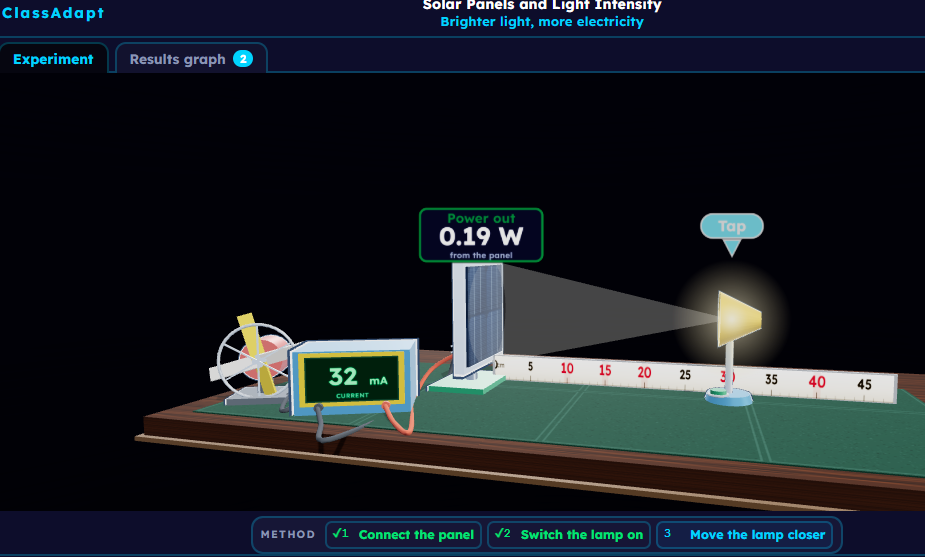
You can explore the simulation here: ClassAdapt: Investigating Solar Panels and Light Intensity
How do solar panels generate electricity?
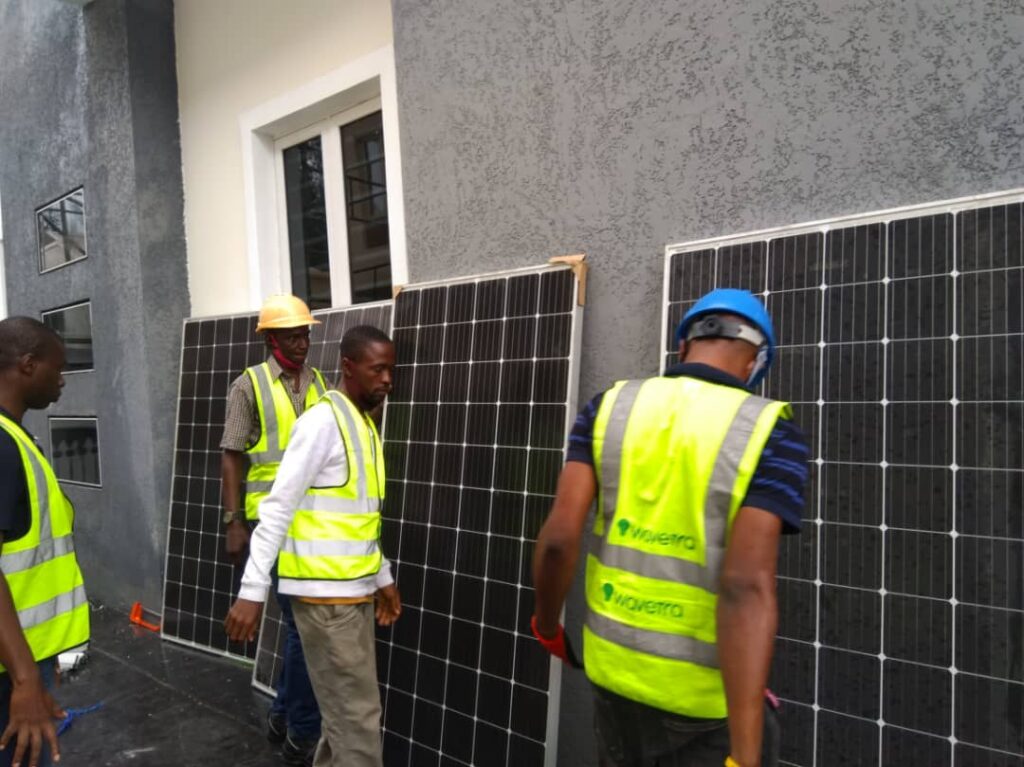
Solar panels use photovoltaic cells to convert light into electrical energy. When light reaches a photovoltaic cell, energy from the incoming photons can cause charge carriers within the semiconductor material to move, producing an electric current.
The amount of electricity produced is affected by several factors, including the intensity of the incoming light, the angle at which light reaches the panel, temperature, the area of the panel exposed to light and the characteristics of the photovoltaic cells.
For this reason, a solar panel does not necessarily produce the same amount of power throughout the day. Conditions such as cloud cover, the position of the Sun and the orientation of the panel can all affect its output. The Institute of Physics’ IOPSpark, for example, identifies light intensity, panel area and orientation as factors that influence solar-panel output.
What is light intensity?
Light intensity describes how much light reaches a particular area. In the context of solar energy, the more radiation arriving at the surface of a photovoltaic panel, generally the more energy is available for conversion into electrical energy.
This makes light intensity an important variable when investigating photovoltaic power generation.
A straightforward way of demonstrating this experimentally is to use a lamp as a light source and change either its brightness or its distance from the solar cell. Educational investigations have used both approaches to examine how changing illumination affects solar-cell output.
The ClassAdapt simulation provides a digital environment in which students can investigate this relationship without needing to set up a physical solar panel, lamp, electrical circuit and measuring equipment.
Exploring the relationship through simulation
The key investigation is straightforward: what happens to the power output of a solar panel as the intensity of light increases or decreases?
Students can use the simulation to explore different light-intensity conditions and observe the resulting change in power generation.
This creates an opportunity to move beyond simply learning that “solar panels use sunlight”. Instead, students can investigate the quantitative relationship between an independent variable, such as light intensity, and the electrical power produced by the panel.
This is particularly useful when teaching students about variables and scientific investigation.
Students can consider:
- What is the independent variable?
- What is the dependent variable?
- Which variables should be controlled?
- What pattern can be observed in the results?
- How does changing the light intensity affect power output?
- What would happen if the light intensity became very low?
- How might the results relate to a real solar panel on a cloudy day?
These questions help connect the simulation with the wider process of scientific enquiry.
Why does increasing light intensity generally increase power?
A greater intensity of incident light means that more light energy is reaching the photovoltaic material. Under suitable conditions, this provides more energy for generating charge carriers and therefore increases the electrical current produced by the cell.
Educational photovoltaic experiments demonstrate this relationship. For example, experimental investigations of solar cells have found that increasing illumination can increase the electrical power available from the cell.
It is important, however, not to oversimplify the physics by assuming that every aspect of solar-panel performance increases in a perfectly linear way under every condition. Real photovoltaic devices have complex current-voltage and power-voltage characteristics, and factors such as temperature and the spectrum of the incoming light also matter.
For a classroom investigation, however, the fundamental relationship provides an excellent starting point for understanding photovoltaic energy.
From the classroom to real solar energy systems
One of the strengths of a simulation is that it allows students to investigate a scientific principle in a controlled environment before considering how it applies to the real world.
Consider a solar panel installed on a building.
On a clear day around midday, the panel may receive relatively high levels of solar radiation. Later in the afternoon, the intensity reaching the panel changes as the Sun’s position changes. Clouds can also reduce the amount of radiation reaching the panel.
The angle of the panel matters as well. IOPSpark notes that solar-panel output can be investigated by changing factors such as tilt, the area exposed and the materials placed between the light source and the panel.
This means that the simulation can be used as a starting point for discussions about the performance of real photovoltaic systems.
Students might investigate questions such as:
Why might a solar panel generate less electricity on a cloudy day?
Why does the orientation of a solar panel matter?
Why might two solar installations produce different amounts of electricity even if they use similar panels?
How could solar-panel positioning be optimised for a particular location?
These questions connect physics concepts with renewable energy, engineering and sustainability.
A useful resource for renewable-energy education
For students of Wavetra Energy Academy studying energy and electricity, solar photovoltaic technology provides an excellent real-world application of physics.
The ClassAdapt simulation can help make this topic more accessible by allowing students to investigate the relationship between light intensity and solar-panel power generation interactively.
It can also support practical-style thinking without requiring access to specialist laboratory equipment. Physical photovoltaic experiments can involve solar cells, lamps, electrical meters, variable loads and light meters. Simulations can provide a complementary approach, particularly when equipment, time or laboratory access is limited.
Recent educational research also highlights the value of photovoltaic simulations and controlled educational platforms for helping students investigate relationships between illumination, current, voltage and power.
For teachers, the simulation could therefore be used as an introduction to photovoltaic technology, as part of a lesson on energy transfers, or as preparation for a practical investigation.
Understanding the bigger picture
Solar power is more than simply placing panels in sunlight. The amount of electrical energy that can be generated depends on the conditions under which the photovoltaic system operates.
Light intensity is one of the fundamental factors.
By investigating it through the ClassAdapt simulation, students can see how changing an environmental condition can influence the electrical output of a photovoltaic system. More importantly, they can begin to think like scientists: identifying variables, observing patterns, interpreting data and connecting a model with the real world.
The Investigating Solar Panels and Light Intensity simulation from UK-based ClassAdapt offers a practical digital way to explore these ideas.
For students learning about electricity, energy, renewable technologies or sustainability, it provides a useful bridge between the physics classroom and one of the technologies playing an increasingly important role in the energy system.
Explore the simulation: Investigating Solar Panels and Light Intensity – ClassAdapt